













Clinical, Microbiological and Treatment Characteristics of Spondylodiscitis: A Six-Year Single- Centre Neurosurgery Experience from a Brucellosis-Endemic Region of Türkiye
Salim Katar1, Adil Can Karaoğlu1, Muhammed Fatih Sarı1, Mehmet Ali Tüz2, Rukiye İnan Sarıkaya2, Emre Fidan3, Hüseyin Utku Adilay11Department of Neurosurgery, Balıkesir University Faculty of Medicine, Balıkesir, Türkiye2Department of Infectious Diseases and Clinical Microbiology, Balıkesir University Faculty of Medicine, Balıkesir, Türkiye
3Balıkesir University Faculty of Medicine, Balıkesir, Türkiye
INTRODUCTION: The microbiological spectrum of spondylodiscitis (SD) varies markedly by region; in Brucella-endemic settings, the etiological profile differs from that of Western cohorts, yet contemporary data from neurosurgical practice in Türkiye are limited. We aimed to characterize SD managed in a tertiary neuro-surgical service in Brucella-endemic Western Türkiye and to identify variables associated with prolonged intravenous antibiotic therapy.
METHODS: Consecutive adult patients with SD treated between January 2020 and December 2025 at a tertiary academic medical center were retrospectively analyzed. Group comparisons were performed using the Mann–Whitney U test, chi-square test, and Fisher's exact test, as appropriate; correlations were assessed using Spearman's rho. A two-sided p<0.05 was considered statistically significant.
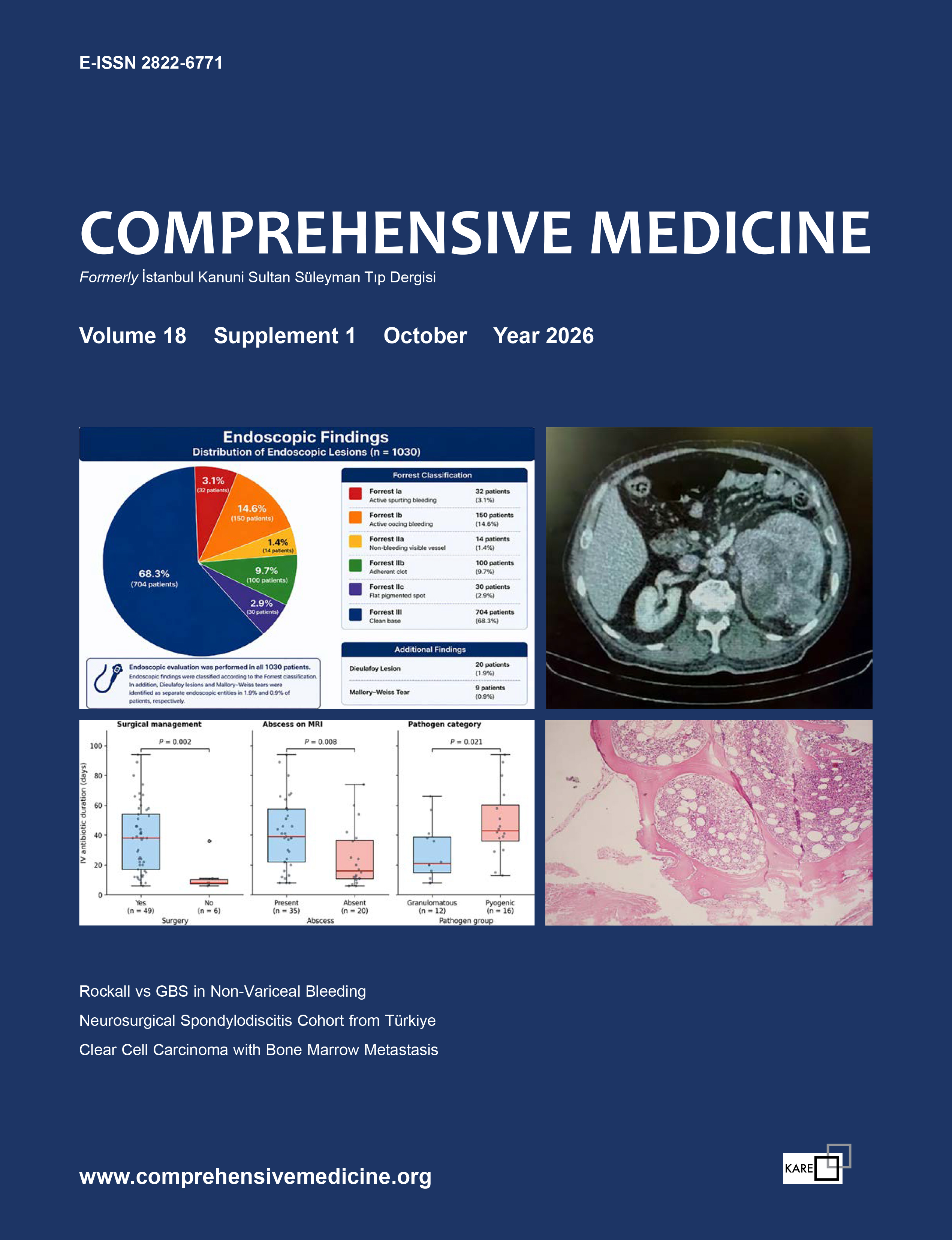
RESULTS: Fifty-six patients were included (median age, 66 years [IQR, 59–71]; 53.6% male; lumbar involvement, 55.4%). Surgery was performed in 49 patients (87.5%; 95% CI, 76.4–93.8%), and an abscess was identified in 35 (62.5%; 95% CI, 49.4–74.0%). A causative organism was isolated in 29 patients (51.8%); Brucella spp. (14.3%) and Mycobacterium tuberculosis (7.1%) predominated over Staphylococcus aureus (3.6%). The median duration of intravenous antibiotic therapy was 36 days (IQR, 13–52). Surgical management (p=0.002) and abscess presence (p=0.008) were associated with longer antibiotic therapy; abscess presence was strongly associated with surgery (Fisher's exact p=0.009). Pyogenic SD required approximately twice the duration of antibiotic therapy compared with granulomatous SD (p=0.021).
DISCUSSION AND CONCLUSION: In this Brucella-endemic neurosurgical cohort, granulomatous pathogens predominated over S. aureus, and abscess presence was the central determinant of both operative intervention and prolonged antimicrobial therapy.
Keywords: Antibiotic treatment, brucellosis, neurosurgery, spinal abscess, spondylodiscitis, vertebral osteomyelitis
Spondilodiskitin Klinik, Mikrobiyolojik ve Tedaviye İlişkin Özellikleri: Türkiye'nin Bruselloz Endemik Bir Bölgesinden Altı Yıllık Tek Merkezli Beyin Cerrahisi Deneyimi
Salim Katar1, Adil Can Karaoğlu1, Muhammed Fatih Sarı1, Mehmet Ali Tüz2, Rukiye İnan Sarıkaya2, Emre Fidan3, Hüseyin Utku Adilay11Balıkesir Üniversitesi Tıp Fakültesi, Beyin ve Sinir Cerrahisi Anabilim Dalı, Balıkesir2Balıkesir Üniversitesi Tıp Fakültesi, Enfeksiyon Hastalıkları Anabilim Dalı, Balıkesir
3Balıkesir Üniversitesi Tıp Fakültesi, Balıkesir
GİRİŞ ve AMAÇ: Spondilodiskitin (SD) mikrobiyolojik etken dağılımı coğrafyaya göre belirgin farklılık gösterir; Bruselloz endemik bölgelerde etken yelpazesi Batı serilerinden farklı olmakla birlikte, Türkiye beyin cerrahisi pratiğinden güncel veriler sınırlıdır. Bu çalışmada Bruselloz endemik Batı Anadolu'da tersiyer bir beyin cerrahisi servisinde takip edilen SD hastalarının özellikleri tanımlanmış ve uzamış intravenöz antibiyotik tedavisi ile ilişkili değişkenler incelenmiştir.
YÖNTEM ve GEREÇLER: Ocak 2020–Aralık 2025 arasında üçüncü basamak bir akademik tıp merkezinde SD tanısı alan ardışık yetişkin hastalar retrospektif olarak incelendi. Grup karşılaştırmalarında Mann–Whitney U, ki-kare ve Fisher kesin testleri uygun şekilde; korelasyon için Spearman rho kullanıldı. İki yönlü p<0.05 anlamlı kabul edildi.
BULGULAR: Toplam 56 hasta dahil edildi (medyan yaş 66 [IQR 59–71]; %53.6 erkek; lomber tutulum %55.4). Hastaların 49'una (%87.5; %95 GA 76.4–93.8) cerrahi uygulandı; 35'inde (%62.5; %95 GA 49.4–74.0) abse saptandı. Etken 29 hastada (%51.8) tanımlandı; Brucella spp. (%14.3) ve Mycobacterium tuberculosis (%7.1) Staphylococcus aureus'un (%3.6) önüne geçti. Medyan IV antibiyotik süresi 36 gün (IQR 13–52) idi. Cerrahi (p=0.002) ve abse varlığı (p=0.008) uzamış antibiyotik tedavisi ile; abse cerrahi ile güçlü ilişkili bulundu (Fisher kesin testi p=0.009). Piyojenik SD, granülomatöz SD'ye göre yaklaşık iki kat uzun antibiyotik tedavisi gerektirdi (p=0.021).
TARTIŞMA ve SONUÇ: Bruselloz endemik bu beyin cerrahisi kohortunda granülomatöz patojenler S. aureus'un önüne geçti; abse varlığı hem cerrahi girişim hem de uzamış antimikrobiyal tedavi için temel belirleyici oldu.
Anahtar Kelimeler: Antibiyotik tedavisi, bruselloz, beyin cerrahisi, omurga apse, spondilodiskit, omurga osteomiyelit
Manuscript Language: English